In the digital era, businesses thrive on visibility, engagement, and meaningful connections. The rise of social media has transformed how brands communicate with audiences, making a social media marketing strategy a cornerstone of modern business growth. From startups to global enterprises, companies use social platforms to build brand awareness, strengthen customer loyalty, and drive sales.
A well-crafted strategy not only enhances online presence but also aligns marketing efforts with business objectives, ensuring measurable and scalable results.
To build a complete digital marketing system, it’s important to combine social media with other channels like PPC—learn more in our guide on The Ultimate Guide to PPC Advertising for Beginners.
This comprehensive guide explores how social media marketing fuels business growth, the essential components of an effective social media marketing strategy, and actionable insights for maximizing return on investment. By understanding the dynamics of social media platforms, analytics, and consumer behavior, businesses can create strategies that deliver sustainable success.
What Is Social Media Marketing?
Social media marketing (SMM) is the use of social media platforms to build a brand, increase sales, and drive website traffic. It involves creating and sharing posts, videos, and ads on platforms like Facebook, Instagram, LinkedIn, and TikTok to build awareness and drive sales. A strong social media marketing strategy connects businesses with their audiences, encourages interaction, and supports long-term growth.
Unlike traditional marketing, social media marketing allows real-time communication and feedback. Brands can respond instantly to comments, track performance through analytics, and adjust campaigns for better results. The main goals are to increase visibility, strengthen relationships, and convert followers into customers. When executed effectively, social media marketing becomes a powerful tool for expanding reach and achieving measurable business success.
The Evolution of Social Media Marketing
From Communication to Commerce
Social media began as a tool for personal connection but quickly evolved into a powerful marketing ecosystem. Platforms like Facebook, Instagram, LinkedIn, and TikTok have become digital marketplaces where brands interact directly with consumers. The shift from traditional advertising to digital engagement has made the social media marketing strategy an indispensable part of business planning.
The Rise of Data-Driven Marketing
Modern marketing thrives on data. Social media platforms provide detailed analytics that help businesses understand audience preferences, behaviors, and trends. A data-driven social media marketing strategy enables brands to make informed decisions, optimize campaigns, and allocate resources effectively.
The Role of Algorithms
Algorithms determine what content users see, influencing engagement and reach. Understanding these algorithms is crucial for developing a social media marketing strategy that ensures visibility. By aligning content with platform algorithms, businesses can increase organic reach and reduce dependency on paid promotions.
The Importance of a Social Media Marketing Strategy
Defining Objectives
A successful strategy begins with clear objectives. Whether the goal is brand awareness, lead generation, or customer retention, defining measurable outcomes ensures focused efforts. Objectives should align with overall business goals to maintain consistency across marketing channels.
Identifying Target Audiences
Understanding the target audience is central to any social media marketing. Demographics, interests, and online behaviors influence content creation and platform selection. Businesses that tailor messages to specific audience segments achieve higher engagement and conversion rates.
Platform Selection
Each social media platform serves a unique purpose. LinkedIn caters to professionals, Instagram emphasizes visual storytelling, and Twitter focuses on real-time updates. A well-structured social media marketing strategy identifies the most relevant platforms for a brand’s audience and objectives.
Content Planning and Creation
Content is the foundation of social media success. A robust social media marketing strategy includes a content calendar that balances promotional, educational, and entertaining posts. High-quality visuals, compelling copy, and consistent branding enhance audience engagement and trust.
Key Components of an Effective Social Media Marketing Strategy
1. Brand Positioning
Brand positioning defines how a company wants to be perceived in the market. A clear brand identity, tone, and message guide all social media activities. A consistent social media marketing reinforces brand values and differentiates the business from competitors.
2. Content Strategy
Content drives engagement. A diversified content mix—videos, infographics, blogs, and live sessions—keeps audiences interested. The social media marketing should emphasize storytelling that resonates emotionally with followers while delivering value.
3. Engagement Tactics
Engagement builds relationships. Responding to comments, hosting Q&A sessions, and encouraging user-generated content help foster a strong community. A proactive social media marketing strategy prioritizes two-way communication to strengthen brand loyalty.
Consistent engagement is essential for long-term brand growth—learn how it impacts business success in How Social Media Marketing Can Transform Your Brand in 2026.
4. Influencer Collaboration
Influencers amplify brand reach. Partnering with credible voices in the industry enhances authenticity and trust. Integrating influencer marketing into the social media marketing can significantly boost visibility and conversions.
5. Paid Advertising
Organic reach has limitations. Paid campaigns on platforms like Facebook Ads or LinkedIn Ads allow precise targeting and measurable outcomes. A balanced social media marketing combines organic and paid efforts for optimal results.
6. Analytics and Optimization
Continuous improvement is vital. Monitoring metrics such as engagement rate, click-through rate, and conversion rate helps refine the social media marketing. Data-driven insights ensure that campaigns evolve with audience preferences.
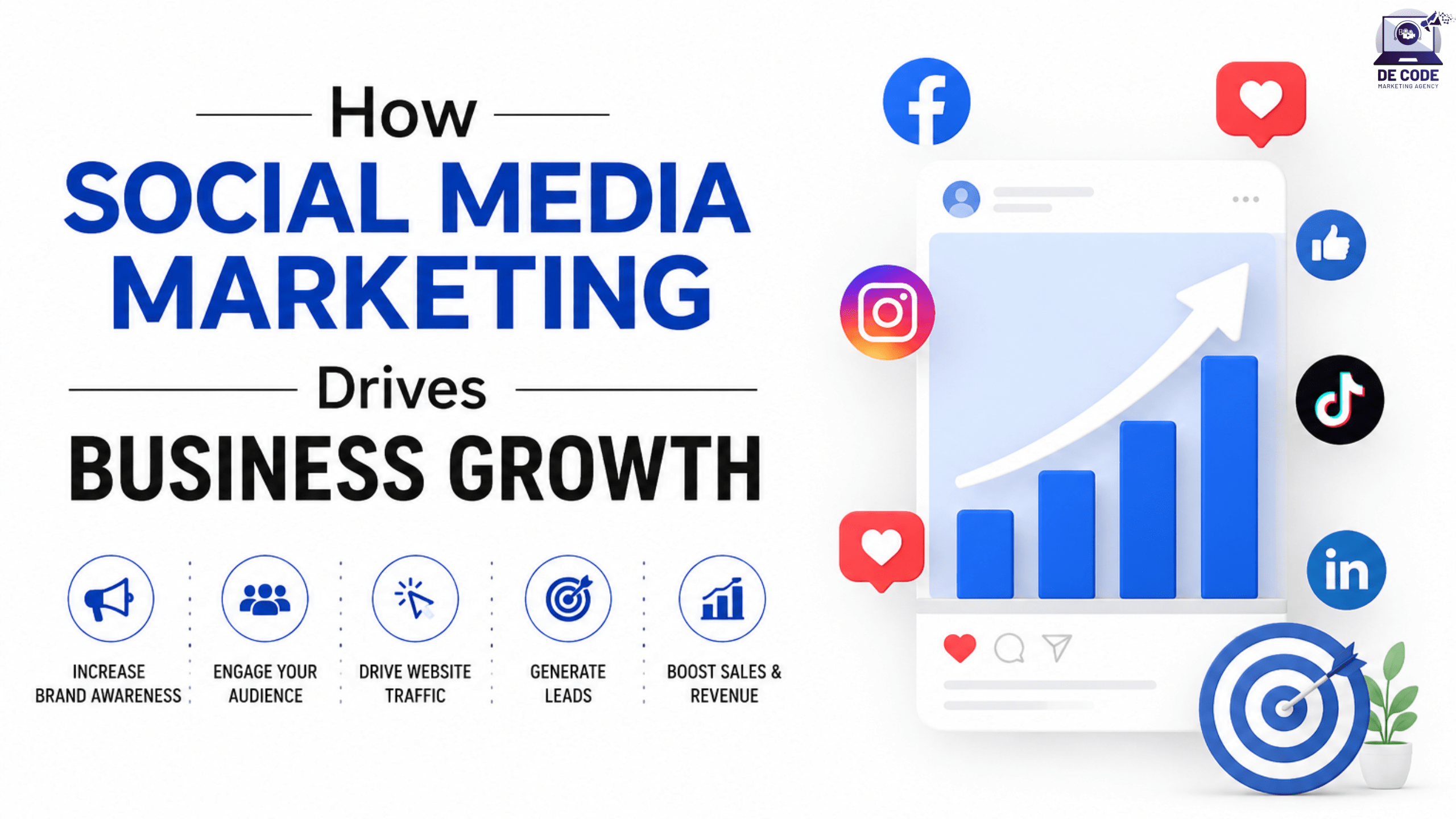
How Social Media Marketing Drives Business Growth
Enhancing Brand Awareness
Social media provides unparalleled exposure. A consistent social media marketing strategy ensures that a brand remains visible across multiple platforms. Regular posting, trending hashtags, and interactive content help increase recognition and improve brand recall.
While social media boosts visibility, building a strong and memorable brand identity is equally important—learn more in our guide on The Importance of Branding in Digital Marketing.
Building Customer Relationships
Social media fosters direct communication between brands and consumers. Through personalized interactions, businesses can build trust and loyalty. A customer-centric social media marketing strategy focuses on meaningful engagement rather than one-way promotion.
Generating Leads and Sales
Social platforms are powerful lead-generation tools. Features like shoppable posts, lead forms, and targeted ads streamline the buyer’s journey. A conversion-focused social media marketing strategy integrates these tools to drive measurable sales growth.
Driving Website Traffic
Social media acts as a gateway to a company’s website. Sharing blog posts, product pages, and landing pages encourages users to explore more. A traffic-oriented social media marketing uses compelling calls-to-action to guide users toward conversion points.
Improving Customer Insights
Social media analytics reveal valuable insights into consumer behavior. By analyzing engagement patterns, sentiment, and feedback, businesses can refine their social media marketing to better meet customer needs.
Strengthening Brand Authority
Consistent, high-quality content positions a brand as an industry leader. Sharing expert opinions, case studies, and educational resources enhances credibility. A thought-leadership-driven social media marketing builds authority and trust.
The Role of Different Platforms in Business Growth
Facebook remains a dominant platform for community building and advertising. Its advanced targeting options make it ideal for personalized campaigns. A social media marketing strategy that leverages Facebook Groups, Ads, and Live sessions can significantly boost engagement.
Instagram’s visual nature makes it perfect for lifestyle and product-based brands. Stories, Reels, and influencer collaborations drive visibility. A visually cohesive social media marketing strategy on Instagram enhances brand aesthetics and emotional connection.
LinkedIn is essential for B2B marketing. Sharing thought leadership content, company updates, and professional insights strengthens credibility. A professional social media marketing strategy on LinkedIn builds networks and attracts business partnerships.
Twitter (X)
Twitter excels in real-time communication. Brands use it for announcements, customer service, and trend participation. A responsive social media marketing strategy on Twitter ensures timely engagement and brand relevance.
TikTok
TikTok’s short-form videos offer immense viral potential. Creative storytelling and challenges can rapidly expand reach. A trend-driven social media marketing strategy on TikTok appeals to younger audiences and boosts brand awareness.
YouTube
YouTube supports long-form content and tutorials. Educational videos and product demonstrations enhance trust. A video-centric social media marketing strategy on YouTube nurtures deeper audience engagement.
Integrating SEO with Social Media Marketing
The Connection Between SEO and Social Media
While social media signals do not directly influence search rankings, they enhance visibility and traffic. A cohesive social media marketing strategy that aligns with SEO principles improves brand discoverability.
Keyword Optimization
Incorporating relevant keywords into social media posts, bios, and hashtags strengthens SEO. Using the focus keyword “social media marketing strategy” consistently across platforms reinforces brand identity and search relevance.
Link Building
Sharing website links on social media drives referral traffic and boosts domain authority. A link-focused social media marketing strategy supports SEO efforts by increasing inbound traffic.
Content Amplification
Social media extends the reach of SEO-optimized content. Promoting blogs, videos, and infographics through a strategic social media marketing strategy ensures that valuable content reaches a wider audience.
Measuring the Success of a Social Media Marketing Strategy
Key Performance Indicators (KPIs)
Tracking KPIs is essential for evaluating effectiveness. Metrics such as engagement rate, follower growth, and conversion rate reveal the impact of a social media marketing strategy.
ROI Analysis
Calculating return on investment helps determine profitability. Comparing campaign costs with generated revenue provides insights into the efficiency of the social media marketing strategy.
A/B Testing
Experimenting with different content formats, posting times, and ad creatives refines performance. A data-backed social media marketing strategy uses A/B testing to identify what resonates best with audiences.
Sentiment Analysis
Monitoring audience sentiment helps assess brand perception. A positive sentiment indicates that the social media marketing strategy aligns with audience expectations and values.
Challenges in Social Media Marketing
Algorithm Changes
Frequent algorithm updates can affect reach and engagement. A flexible social media marketing strategy adapts to these changes through continuous learning and experimentation.
Content Saturation
With millions of posts shared daily, standing out is challenging. A creative social media marketing strategy focuses on originality and storytelling to capture attention.
Managing Negative Feedback
Public criticism can harm reputation. A crisis management plan within the social media marketing strategy ensures timely and professional responses to negative comments.
Maintaining Consistency
Consistency across platforms is vital for brand recognition. A structured social media marketing strategy includes scheduling tools and brand guidelines to maintain uniformity.
Future Trends in Social Media Marketing
Artificial Intelligence and Automation
AI tools are transforming social media marketing by streamlining content creation, scheduling, and performance analysis. From automated posting to advanced audience insights, AI helps businesses make faster and more informed decisions.
Integrating AI into a social media marketing strategy enhances efficiency while enabling deeper personalization. Tools like chatbots, predictive analytics, and AI-driven recommendations allow brands to deliver the right content to the right audience at the right time.
As competition grows, leveraging AI and automation is becoming essential for staying ahead and maximizing results. To understand how these technologies fit into a broader strategy, explore The Ultimate Guide to Digital Marketing for Small Businesses.
Augmented Reality (AR) Experiences
AR filters and virtual try-ons create immersive experiences. A forward-thinking social media marketing strategy leverages AR to engage audiences interactively.
Social Commerce
The integration of shopping features within social platforms simplifies purchasing. A commerce-driven social media marketing strategy capitalizes on this trend to boost sales.
Video Dominance
Video content continues to outperform other formats. A video-first social media marketing strategy ensures higher engagement and retention.
Sustainability and Social Responsibility
Consumers favor brands with ethical values. A purpose-driven social media marketing strategy highlights sustainability initiatives to build trust and loyalty.
Case Studies
Case Study 1: Nike
Nike’s campaigns emphasize empowerment and inclusivity. Its social media marketing strategy combines storytelling, influencer partnerships, and user-generated content to foster community and brand loyalty.
Case Study 2: Starbucks
Starbucks uses social media to create personalized experiences. Its social media marketing strategy focuses on customer engagement, seasonal promotions, and interactive content that strengthens emotional connections.
Case Study 3: HubSpot
HubSpot’s educational content positions it as a thought leader. Its social media marketing strategy integrates blogs, webinars, and tutorials to attract and nurture leads effectively.
Building a Sustainable Social Media Marketing Strategy
Step 1: Conduct a Social Media Audit
Assess current performance, identify strengths, and uncover opportunities. A comprehensive audit forms the foundation of a data-informed social media marketing strategy.
Step 2: Set SMART Goals
Goals should be Specific, Measurable, Achievable, Relevant, and Time-bound. SMART objectives guide the direction of the social media marketing strategy.
Step 3: Develop a Content Calendar
A content calendar ensures consistency and organization. It helps align the social media marketing strategy with seasonal trends and campaign timelines.
Step 4: Engage and Interact
Active engagement humanizes the brand. A responsive social media marketing strategy prioritizes authentic communication with followers.
Step 5: Monitor and Adjust
Regular analysis ensures continuous improvement. A flexible social media marketing strategy evolves based on performance data and audience feedback.
Advanced Techniques for Maximizing Social Media ROI
Leveraging User-Generated Content
User-generated content (UGC) builds authenticity and trust by showcasing real customer experiences. Encouraging users to share reviews, photos, and testimonials helps create a strong sense of community while increasing organic reach.
A UGC-driven social media marketing strategy enhances credibility, reduces content creation costs, and improves audience engagement. It also plays a key role in influencing purchasing decisions by providing genuine social proof.
To see how social media contributes to overall brand growth, explore How Social Media Marketing Can Transform Your Brand in 2026.
Retargeting Campaigns
Retargeting helps re-engage users who have interacted with a brand but haven’t converted. A data-driven social media marketing strategy uses retargeting ads to remind potential customers of products or services, increasing conversion rates.
Cross-Platform Integration
Integrating multiple platforms ensures consistent messaging. A unified social media marketing strategy connects Facebook, Instagram, LinkedIn, and YouTube campaigns for cohesive storytelling and broader reach.
Utilizing Chatbots
Chatbots improve customer service by providing instant responses. Incorporating chatbots into a social media marketing strategy enhances user experience and supports lead generation.
Community Building
Communities foster loyalty and advocacy. Creating groups or forums where customers share ideas strengthens relationships. A community-focused social media marketing strategy nurtures long-term engagement.
The Psychological Impact of Social Media Marketing
Emotional Connection
Emotions drive decisions. A social media marketing strategy that evokes happiness, inspiration, or empathy creates stronger bonds with audiences.
Social Proof
People trust peer recommendations. Showcasing testimonials, reviews, and influencer endorsements within a social media marketing strategy reinforces credibility.
FOMO (Fear of Missing Out)
Limited-time offers and exclusive content trigger urgency. A social media marketing strategy that leverages FOMO encourages immediate action and boosts conversions.
Storytelling and Authenticity
Authentic storytelling humanizes brands. Sharing behind-the-scenes content and real experiences makes a social media marketing strategy relatable and memorable.
The Economic Impact of Social Media Marketing
Social media contributes significantly to economic growth by enabling small businesses to compete globally. A scalable social media marketing strategy allows startups to reach international audiences without massive budgets. It reduces marketing costs, increases brand exposure, and creates employment opportunities in digital marketing sectors.
Moreover, social media advertising generates measurable returns. Businesses can track every click, impression, and conversion, ensuring that marketing budgets are used efficiently. A performance-oriented social media marketing strategy maximizes ROI by focusing on high-impact campaigns.
Ethical Considerations in Social Media Marketing
Transparency
Honesty builds trust. A transparent social media marketing strategy discloses partnerships, sponsorships, and data usage policies.
Privacy Protection
Respecting user data is essential. A compliant social media marketing strategy adheres to privacy laws like GDPR and ensures ethical data handling.
Avoiding Manipulation
Ethical marketing avoids deceptive tactics. A responsible social media marketing strategy focuses on genuine value rather than exploiting psychological triggers.
The Future of Business Growth Through Social Media
The future of business growth lies in personalization, automation, and innovation. Artificial intelligence will continue to refine targeting, while immersive technologies like AR and VR will redefine engagement. A forward-looking social media marketing strategy will integrate these advancements to create seamless, personalized experiences.
As consumer expectations evolve, authenticity and purpose will become central to brand success. Businesses that align their social media marketing strategy with social values and sustainability will build stronger emotional connections and long-term loyalty.
FAQ: How Social Media Marketing Drives Business Growth
1. What is social media marketing?
Social media marketing is the use of platforms like Facebook, Instagram, LinkedIn, and TikTok to promote products or services, engage with audiences, and build brand awareness.
2. How does social media marketing help businesses grow?
It increases visibility, drives website traffic, builds customer relationships, and generates leads, ultimately boosting sales and long-term growth.
3. Which social media platform is best for business growth?
The best platform depends on your target audience. For example, LinkedIn works well for B2B, while Instagram and TikTok are effective for visual and younger audiences.
4. How often should businesses post on social media?
Consistency matters more than frequency. Most businesses benefit from posting 3–5 times per week, depending on the platform and audience engagement.
5. What type of content performs best on social media?
Engaging content such as videos, tutorials, user-generated content, behind-the-scenes posts, and interactive polls typically perform best.
6. Can social media marketing increase sales directly?
Yes, through targeted ads, promotions, and shoppable posts, businesses can convert followers into customers and drive direct revenue.
7. How important is engagement in social media marketing?
Engagement (likes, comments, shares) builds trust and loyalty, which are essential for long-term customer relationships and brand credibility.
8. Is paid advertising necessary for growth?
While organic reach is valuable, paid advertising helps businesses reach a wider and more targeted audience quickly, accelerating growth.
Conclusion
Social media has redefined how businesses connect, communicate, and grow. A well-executed social media marketing strategy is no longer optional—it is essential for achieving sustainable success in a competitive digital landscape. By combining creativity, data analytics, and strategic planning, businesses can harness the full potential of social media to enhance brand visibility, drive sales, and build lasting customer relationships.
The future of business growth lies in adaptability and innovation. Companies that invest in a dynamic social media marketing strategy will continue to thrive, turning followers into loyal customers and engagement into measurable success.