You built a website. You published content. But when you search for your business on Google, it is nowhere to be found.
This is the reality for thousands of businesses across Nepal and beyond. Having a website is no longer enough. If people cannot find you on Google, your competitors who do show up are taking the customers that should be yours.
De Code Marketing Agency is a Kathmandu-based digital agency that helps businesses grow their online presence through SEO, web development, and content marketing. This guide reflects the exact strategies their team applies for clients every day.
SEO is the process of improving your website so Google ranks it higher when people search for topics related to your business. It is not about tricks. It is about building something genuinely useful and making sure Google can find, understand, and trust it.
The good news is that SEO is not reserved for big brands with large budgets. With the right knowledge and consistent effort, any business regardless of size or industry can earn a spot on the first page of Google and attract a steady stream of organic traffic without spending on ads.
SEO is just one part of a broader online strategy. If you want to understand how everything works together, check out our ultimate guide to digital marketing for small businesses.
How Google Works

Google does three things: it crawls, indexes, and ranks.
Crawling refers to following the links on a page to new pages, and continuing to find and follow links on new pages to other new pages. Google sends automated bots across the internet that follow links and read the content on every page they visit.
Indexing is storage. After crawling a page, Google saves it in a massive database. Only indexed pages can appear in search results. If your page is not indexed, no one will find it through Google no matter how good the content is.
Ranking is selection. When someone searches, Google scans the index and scores every relevant page based on hundreds of signals; relevance, speed, authority, and user experience then lists them from best to least.
Your job is to give Google every reason to crawl your site easily, index your pages fully, and rank them as high as possible.
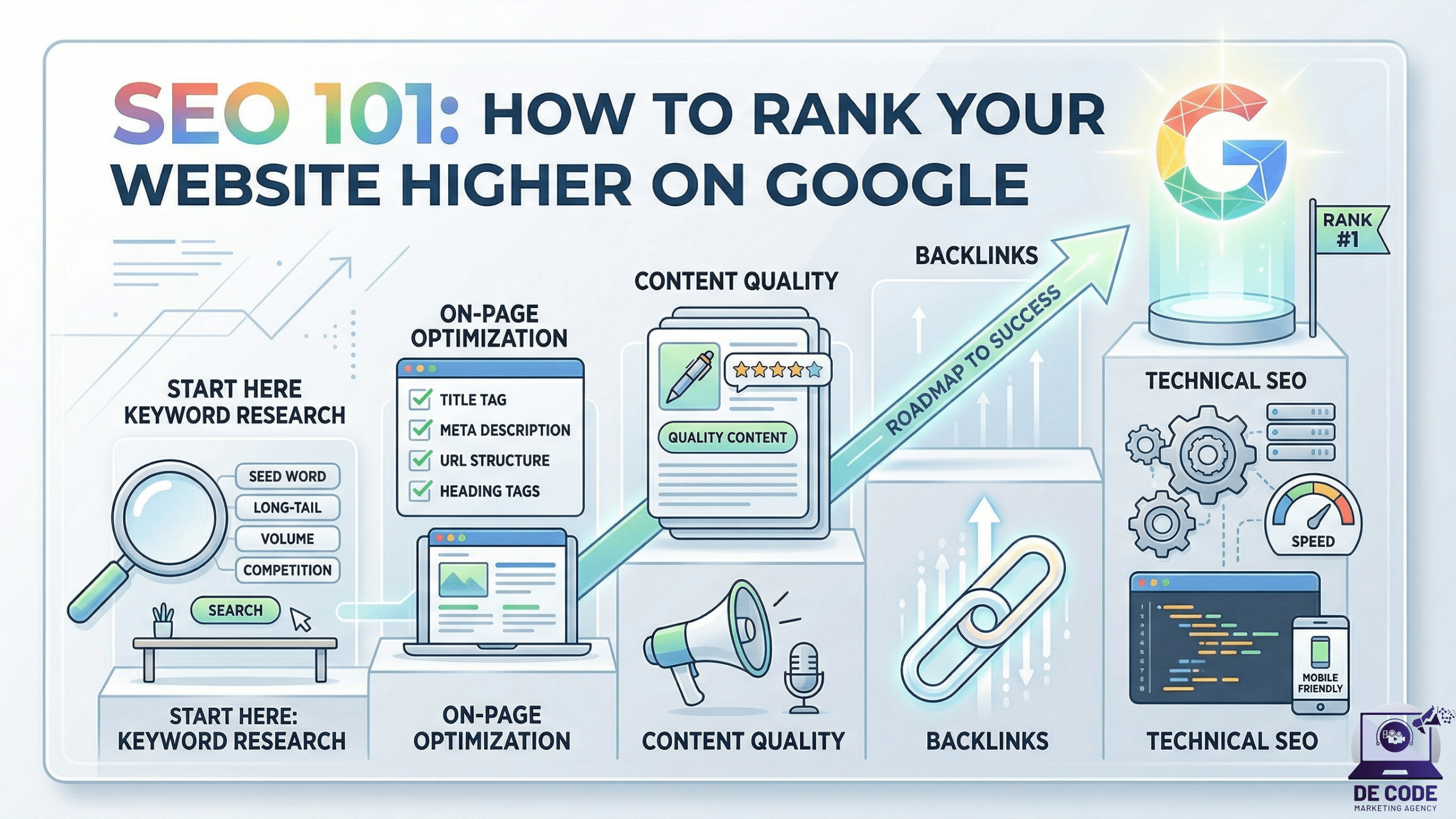
Keyword Research: Know What People Are Searching For

Before writing a single word, you need to know what your audience is actually searching for. Keyword research is the foundation of your entire SEO strategy.
A keyword is any phrase someone types into Google. If you run a bakery in Kathmandu, your customers might search “best bakery Kathmandu” or “custom cake Nepal.” If your website is not built around those phrases, Google cannot match you with those searches.
Short-Tail vs. Long-Tail Keywords
Short-tail keywords are broad “shoes,” “SEO,” “laptop.” They attract high search volumes but face fierce competition. A new website trying to rank for “SEO” is competing against thousands of established sites.
Long-tail keywords are specific “SEO services for small businesses in Nepal” or “affordable web design Kathmandu.” They have lower search volumes but much higher conversion rates. The people using them know exactly what they want.
For most businesses just starting with SEO, long-tail keywords are where to focus first.
How to Find the Right Keywords
Start with Google itself. Type your topic into the search bar and study the autocomplete suggestions. Scroll to the bottom and review the “Related Searches” section. Check the “People Also Ask” box. These are real queries people type every day and they cost you nothing to research.
Then use free tools to go deeper. Google Keyword Planner shows search volumes and competition levels. Ubersuggest generates keyword ideas and difficulty scores. AnswerThePublic maps out the questions people ask around any topic.
Finally, study what is already ranking. Search your target keyword and examine the top five results. What topics do they cover? What questions do they answer? That tells you the standard you must match and where you can go further.
Match Keywords to Intent
Someone searching “what is SEO” wants an explanation. Someone searching “SEO agency Kathmandu price” is close to hiring. Someone searching “hire SEO expert Nepal” is ready to act right now.
Publish the wrong type of content for the intent behind a keyword and you will get traffic that never converts. Group your keywords by intent informational, commercial, transactional and match the right content format to each.
On-Page SEO: Optimize What You Control

On-page SEO covers every element within your pages that you can directly control. Most websites have significant room for improvement here, which means this is where the quickest wins are found.
Title Tags
The title tag is the blue headline in Google search results and one of the strongest on-page ranking signals. Keep it under 60 characters, place your primary keyword near the beginning, and write it so people actually want to click it.
Weak: Welcome to Our Website Strong: SEO Services in Kathmandu
Meta Descriptions
The meta description appears below your title in search results. It does not directly affect rankings but strongly influences click-through rates. Keep it under 160 characters, include your keyword naturally, and give readers a clear reason to choose your page.
Headings
Use one H1 per page containing your primary keyword. Use H2 and H3 headings to organize your content into clear sections. This helps readers navigate and helps Google understand everything your page covers. Well-structured content also increases your chances of earning featured snippets the answer boxes that appear above all other results.
URLs
Keep URLs short, descriptive, and keyword-rich.
Bad: yoursite.com/post?p=4872 Good: yoursite.com/blog/seo-tips-nepal
Images and Internal Links
Add descriptive alt text to every image. This improves accessibility, helps Google index your images, and adds keyword context to your page. Also compress images before uploading large files are one of the most common causes of slow load times.
Link your pages to each other using relevant anchor text. Internal links help Google discover your content, spread authority across your site, and keep visitors engaged longer.
Technical SEO: Build a Foundation Google Can Trust

Technical SEO is the infrastructure everything else depends on. Strong content and quality backlinks will underperform if your site has crawl errors, loads slowly, or does not work properly on mobile.
Page Speed
Speed is a direct ranking factor. Google measures it through Core Web Vitals metrics that assess how quickly your main content loads, how fast the page responds to interaction, and whether the layout shifts unexpectedly during loading.
Run your site through Google PageSpeed Insights. Common issues include uncompressed images, render-blocking scripts, missing browser caching, and slow server response times. Aim for a score above 90 on both mobile and desktop.
Mobile Optimization
Over 60 percent of Google searches happen on mobile devices. Google also uses the mobile version of your site as the primary basis for ranking called mobile-first indexing. If your site is not fully responsive, you are losing rankings and customers every day.
HTTPS
If your site runs on HTTP, fix it today. Google treats HTTPS as a ranking signal and browsers show a “Not Secure” warning on HTTP pages, which causes visitors to leave immediately. SSL certificates are free through most hosting providers.
XML Sitemap and Search Console
An XML sitemap lists all your important pages and helps Google discover and crawl them efficiently. Submit it through Google Search Console a free tool that shows which pages are indexed, which queries drive traffic to your site, any crawl errors, and your Core Web Vitals scores. Check it every week.
Schema Markup
Schema markup is code you add to your pages to help Google display rich results star ratings, FAQ dropdowns, product prices, and event details directly in search results. These enhanced listings stand out visually and earn significantly higher click-through rates than standard results. You do not need to be a developer to implement it. Google’s Structured Data Markup Helper walks you through the process step by step, and plugins like Rank Math handle it automatically for WordPress sites.
Link Building: Earn Authority from Other Sites

When another website links to yours, Google treats it as a vote of confidence. The more quality sites that link to you, the more authoritative your site appears and the higher it tends to rank.
Quality matters far more than quantity. One link from a respected industry publication outweighs a hundred links from irrelevant, low-authority blogs. Buying links or using link schemes risks a Google penalty that can wipe out your rankings overnight.
Create content worth linking to: Original research, detailed guides, and unique data attract links naturally because other writers want to reference them.
Write guest posts: Contribute articles to reputable sites in your industry. Most allow a link back to your site. Always prioritize genuine audiences over sites that exist solely to sell placements.
Claim local citations: For Nepal-based businesses, getting listed in local directories and business associations builds local authority and earns consistent backlinks. Keep your name, address, and phone number identical across every listing.
Fix broken links: Find pages in your niche linking to dead URLs and suggest your content as a replacement. Website owners appreciate the heads-up, and you earn a natural backlink in return.
Earn press mentions: Reach out to journalists and bloggers who cover your industry. Share original data, comment on trends, and position yourself as a go-to expert. When your insights get cited in an article, you gain both a quality backlink and wider brand visibility.
Content Strategy: Build Traffic That Compounds
SEO and content are inseparable. Google’s purpose is to connect people with useful information. Websites that consistently publish helpful content earn higher rankings and more traffic, traffic that keeps growing over time without additional ad spend.
Write for Your Audience First
Every piece of content should answer one question: what does my audience need, and how can I answer it better than anyone else? Think about the questions your customers ask before hiring you. Those questions are your content calendar.
Use Topic Clusters
Build content around clusters rather than isolated posts. Choose a broad subject “digital marketing for Nepali businesses” and create one comprehensive pillar page. Then write supporting articles on specific subtopics and link them all back to the pillar. This signals to Google that your site has deep, authoritative coverage of a subject rather than scattered posts.
Update Old Content
Refreshing an existing article with new information and better examples often produces faster ranking gains than writing something entirely new. Google values freshness. Review your top pages every few months and update anything that is slipping.
Be Consistent
One of the most overlooked aspects of content strategy is simply showing up regularly. Businesses that publish consistently — whether that is once a week or twice a month build authority faster than those who publish in bursts and then go quiet for months. Google notices publishing patterns. A consistent schedule tells the algorithm that your site is active, maintained, and worth revisiting. Pick a realistic frequency and stick to it. Consistency over time will always outperform occasional bursts of effort.
Local SEO: Win in Your Own Backyard

If your business serves a specific location in Nepal, local SEO is one of your highest-return channels. Local searches carry enormous commercial intent someone searching “digital agency Kathmandu” is ready to hire, not just browsing.
Google Business Profile
Claim and fully optimize your Google Business Profile. This is the listing that appears in Google Maps and the local results block at the top of location-based searches. Fill out every field name, category, address, phone, services, hours. Upload quality photos. Respond to every review. Post regular updates. The more complete and active your profile, the higher it ranks.
NAP Consistency
Your Name, Address, and Phone Number must be exactly identical across your website, Google Business Profile, social media, and every directory. Inconsistencies weaken your local authority.
Reviews
Reviews are a significant local ranking factor. Ask every satisfied client to leave a review on your Google Business Profile. Respond professionally to all reviews. A business with 50 recent positive reviews will consistently outrank a competitor with five, even if that competitor has a stronger website.
Measuring SEO Progress
SEO without measurement is guesswork. Track these key numbers monthly.
Organic traffic — visitors from search engines each month. Steady growth confirms your strategy is working.
Keyword rankings — where your target pages appear in search results. Drop in rankings signals a problem to investigate.
Click-through rate — percentage of people who see your listing and click it. A low rate means rewriting your title tag or meta description.
Bounce rate and time on page — whether visitors find your content useful. High bounce rates signal a mismatch between what people expected and what they found.
Conversions from organic traffic — leads, sign-ups, or sales driven by SEO. This is the number that actually matters for your business.
Google Search Console and Google Analytics 4 are free, reliable, and together give you everything you need to make smart decisions. Set up both from the start and check them regularly. The data they provide will tell you exactly where to focus your energy for the biggest impact. Do not guess when you can measure.
FAQ

1. What is SEO and why is it important?
SEO (Search Engine Optimization) is the process of improving your website so it ranks higher on search engines like Google. It is important because higher rankings bring more organic (free) traffic, which can lead to more customers and sales.
2. How long does SEO take to show results?
SEO is a long-term strategy. Typically, it takes 3 to 6 months to start seeing noticeable improvements, depending on your competition, content quality, and consistency.
3. What are the main types of SEO?
There are three main types:
- On-page SEO – Optimizing content, keywords, headings, and internal links
- Off-page SEO – Building backlinks and authority
- Technical SEO – Improving site speed, mobile-friendliness, and indexing
4. What are keywords in SEO?
Keywords are the words or phrases people type into search engines. Using the right keywords in your content helps Google understand what your page is about and rank it accordingly.
5. How do I find the right keywords?
You can use tools like Google Keyword Planner, Ubersuggest, or Ahrefs. Focus on keywords with good search volume and low competition, especially if your website is new.
6. Does content quality affect SEO rankings?
Yes, high-quality, informative, and original content is one of the most important ranking factors. Google prioritizes content that provides real value to users.
7. What is on-page SEO?
On-page SEO involves optimizing elements on your website such as titles, meta descriptions, headings, images, and content to improve search rankings.
Final Thoughts
SEO is a long game. Meaningful results take three to six months to build, but the businesses that commit consistently publishing helpful content, fixing technical issues, earning quality links build a traffic channel that grows month after month without ongoing ad spend.
Every improvement you make adds to a foundation that compounds over time. Unlike paid ads that stop the moment your budget runs out, SEO keeps working for you around the clock.
Start with the basics in this guide. Get your technical foundation right. Publish content that genuinely answers your audience’s questions. Track what matters and improve as you learn.
Code in Nepal is here to help from full SEO audits to end-to-end campaign management for businesses across Nepal and beyond.